Wellness ExperienceMap every moment, choose how it should feel, and design the ones that matter first.
Shop Strategy card deck Hue & Heal Studio
Design a Wellness Experience
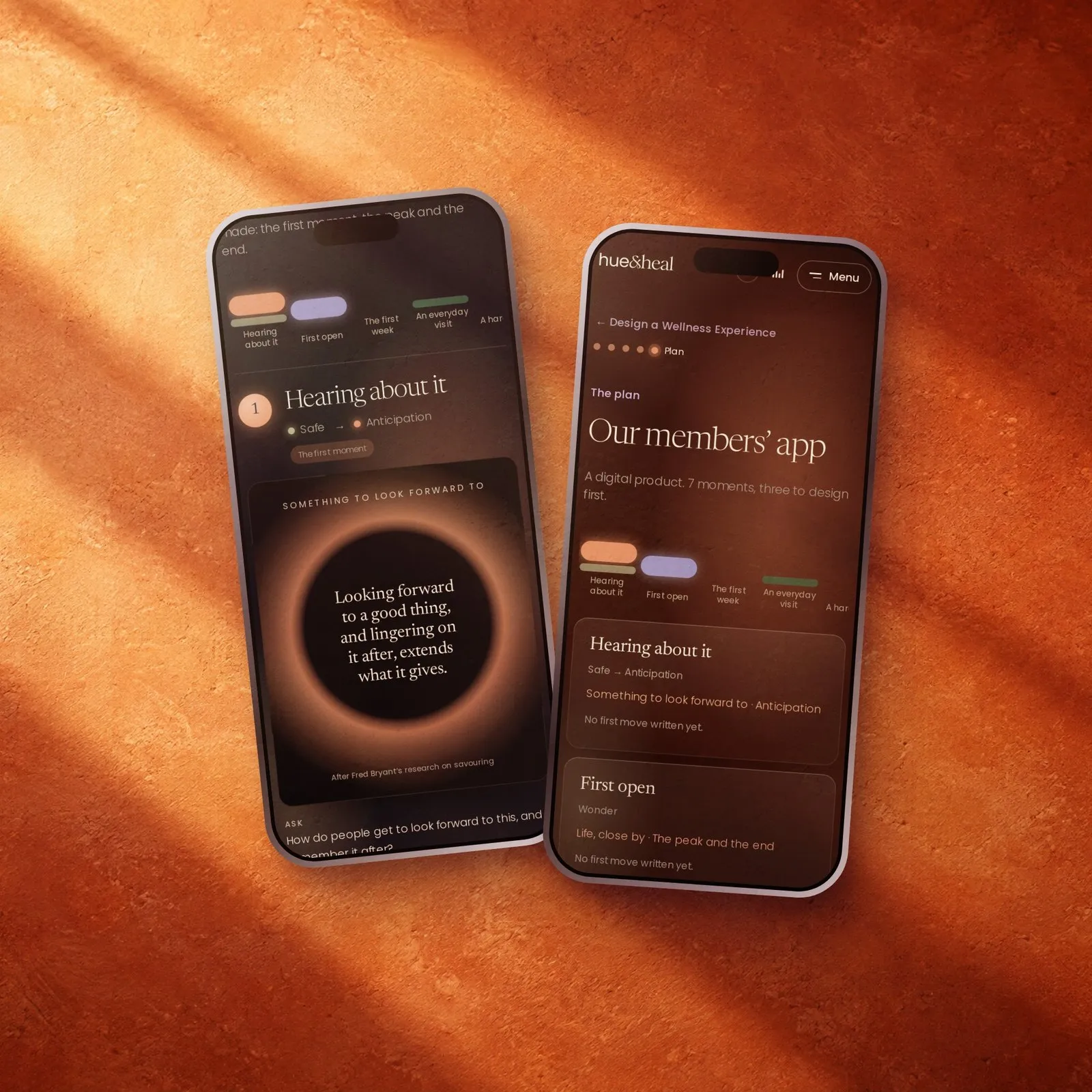
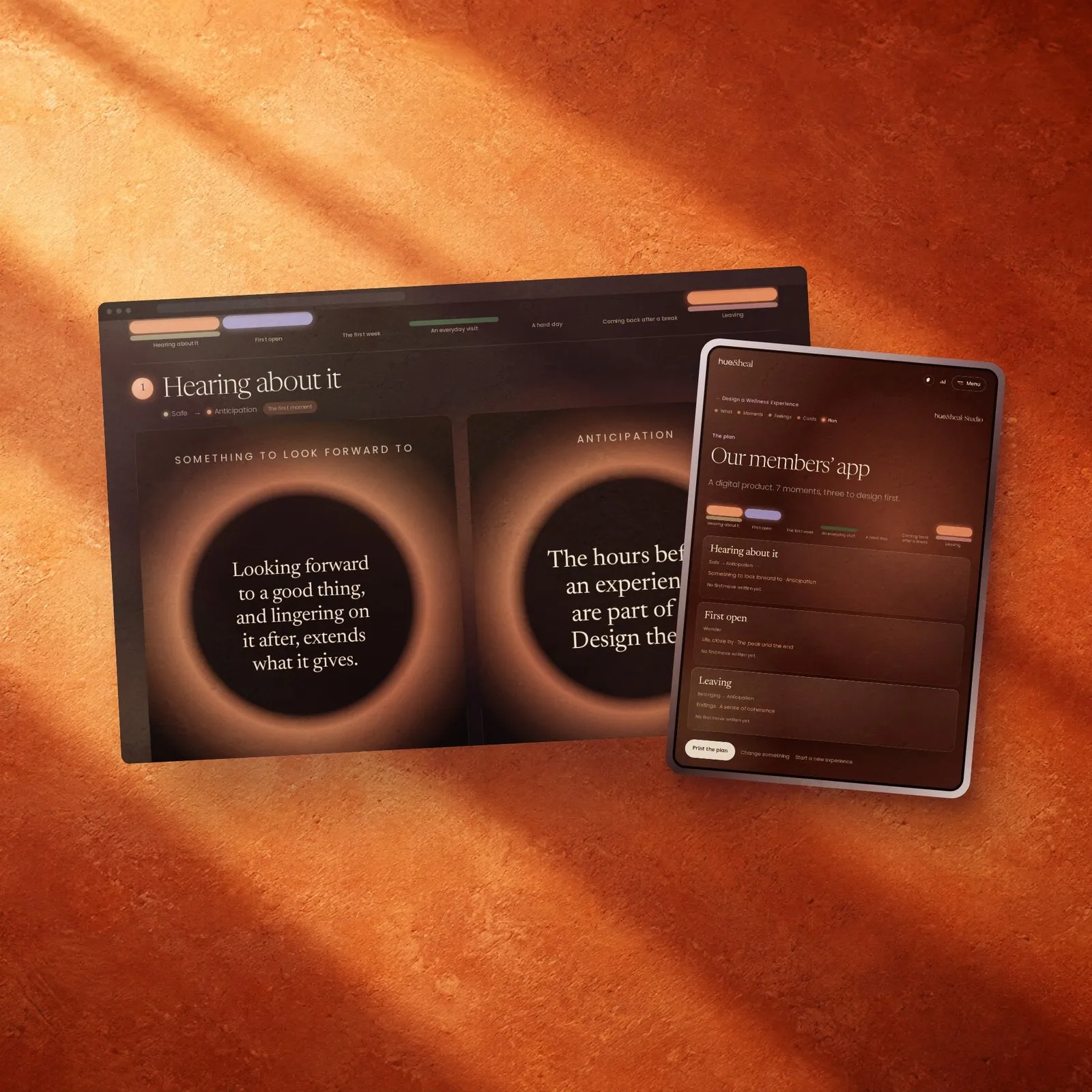
The strategy card deck we use with founders. Map an experience moment by moment, decide how each part should feel, and find where to start.
£49
- The full deck of sixteen principles, played online
- Unlimited experiences, for your whole team
- Your plan to print, keep or email
- Every future card we add
- Instant access
- Plays in your browser
- Secure checkout with Stripe
Turn a card over.
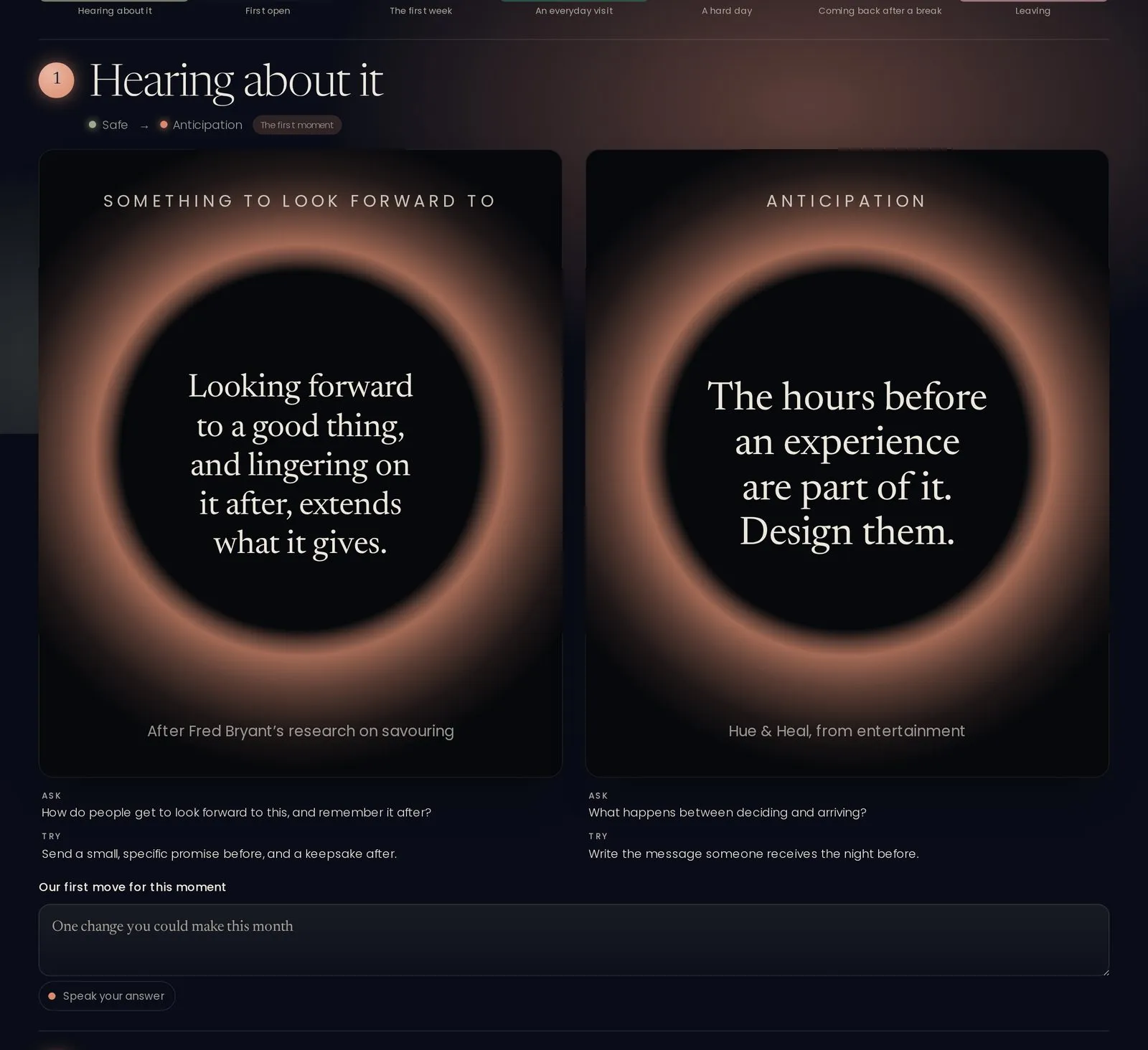
Every card is a principle with a question to ask of your experience and something to try.
For founders and teams
Why the experience is the business.
In wellness, what you sell is how people feel at every moment they spend with you. These findings are why we start there, and why we made this deck for the teams we work with.
More than 25%
In financial services, Bain found that a 5% increase in customer retention produced more than a 25% increase in profit. Keeping people is where the value is.
Frederick F. Reichheld, Prescription for Cutting Costs, Bain & Company, 20015 to 10%
Companies that lead on customer experience can grow revenue by 5 to 10% and reduce costs by 15 to 25% within two or three years.
The CEO guide to customer experience, McKinsey Quarterly, 201655 studies
A review of 55 studies found that a better patient experience goes with safer, more effective care, and with people sticking to treatment and using preventive care.
Doyle, Lennox and Bell, BMJ Open, 2013$6.8 trillion
The global wellness economy reached $6.8 trillion in 2024 and is projected to reach $9.8 trillion in 2029. With more choice every year, how it feels is what sets you apart.
Global Wellness Institute, 2025 Global Wellness Economy Monitor
How the deck helps a company thrive
- Find the moments that bring people back, and design those first rather than everything at once.
- Give your whole team one shared map of the experience, from first hearing about you to coming back.
- Decide with proven principles, each with a question to ask and something to try this month.
- Keep people’s trust by leaving behind streaks, endless feeds and guilt as a way to keep them.
Pioneers of wellness experience
The principles, in practice.
Hospitals, clinicians and designers who changed how care feels, and what happened next. Each one is behind a card in the deck.
A gentler ending
In a trial with 682 colonoscopy patients, half had a short, gentler period added to the end of the procedure.
They remembered the whole experience as less unpleasant, and were slightly more likely to come back for a repeat.
Memories of colonoscopy: a randomized trial, Pain, 2003Everyone is a caregiver
From 2010, every one of its 43,000 employees took part in a half day caregiver experience, and managers were trained to keep staff engaged.
Overall patient satisfaction rose from the 55th to the 92nd percentile among about 4,600 US hospitals.
Jeff Durr, How Cleveland Clinic engaged its employees and transformed the patient experience, Gallup, 2013; Merlino and Raman, Health Care’s Service Fanatics, Harvard Business Review, 2013Redesigning the handover
They watched real nursing shift changes, then prototyped a handover held at the bedside, with the patient.
Nurses reached patients at the start of a shift three times faster in the pilot, with more time for nursing.
Christi Zuber, Kaiser Permanente Innovation Consultancy, 2010; Tim Brown, Design Thinking, Harvard Business Review, 2008A scan as an adventure
He redesigned children’s scanner rooms as stories, a space adventure, a camping trip, without changing the machines inside.
The machines and the scan stayed the same. What changed was how the hour felt to a child, and to the parent beside them.
A Scanner Not So Darkly, Milwaukee Magazine, 2013A kitchen table, not a waiting room
Her account of being a cancer patient became the brief for architect designed centres built around a kitchen table.
In 2024, 98% of visitors said Maggie’s met their needs and 97% said it improved their ability to manage stress.
Maggie’s Impact Report 2024A view of trees
He compared surgical patients whose window looked onto trees with patients whose window faced a brick wall.
Those with the view of trees left hospital sooner, after 7.96 days against 8.70, and needed fewer strong painkillers.
View through a window may influence recovery from surgery, Science, 1984
How it plays.
- 01
Lay out the moments
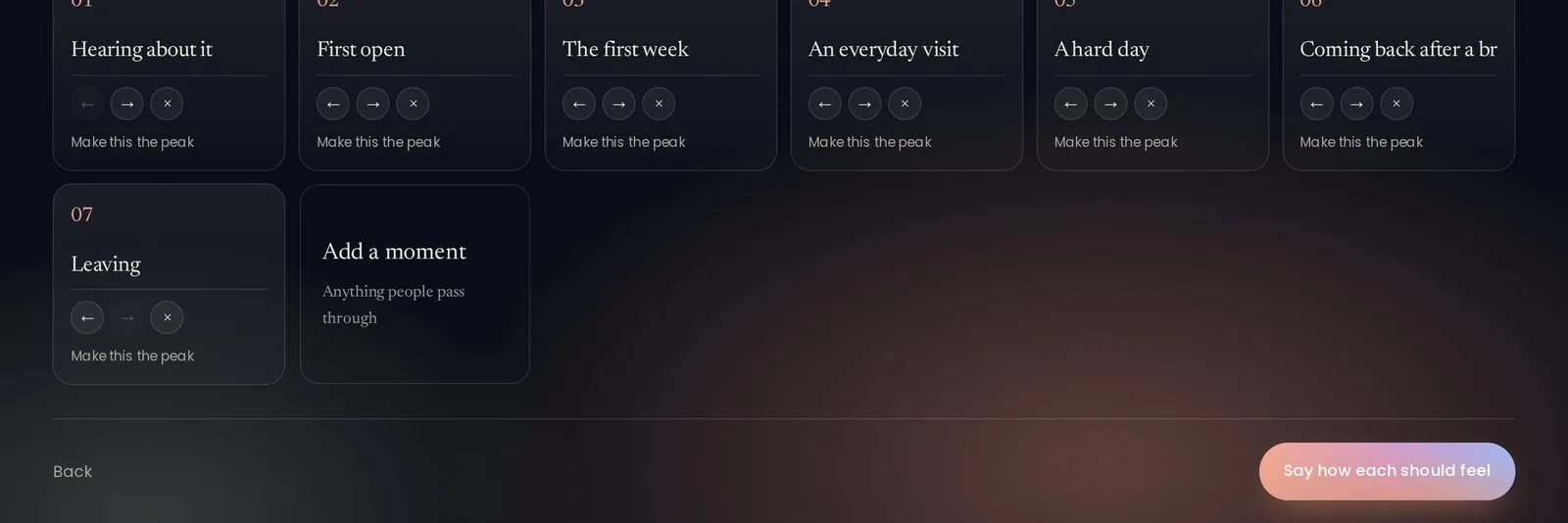
Choose what you are designing, then set out its moments, from first hearing about it to coming back.
- 02
Say how each should feel
For every moment, how it feels today and how it should feel. The gaps show you where to begin.
- 03
Draw the principles
The deck deals the principles that help the moments that matter most, each with a question and something to try.
- 04
Leave with a plan
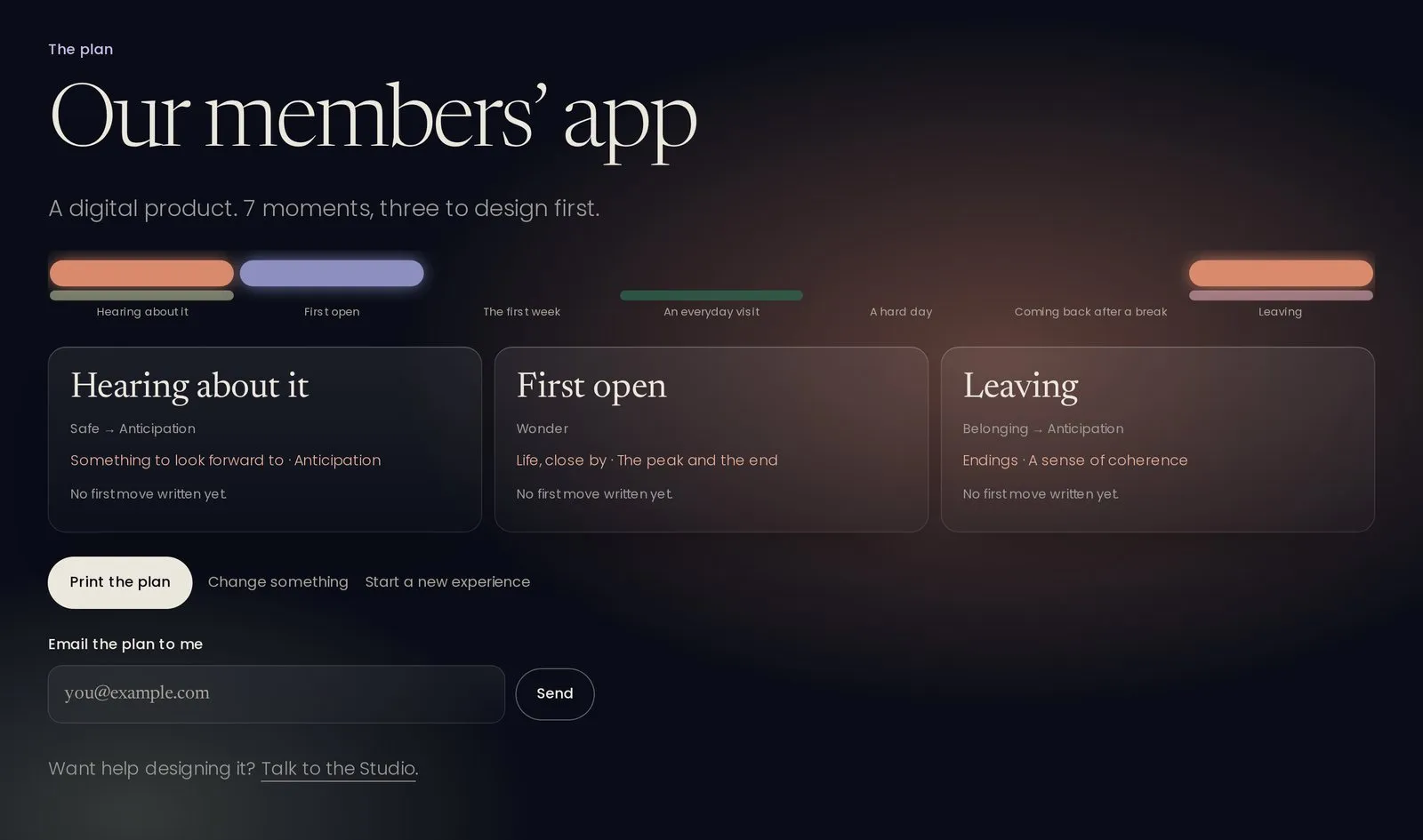
The three moments to design first and your first move for each, to print, keep or send to yourself.
On whose shoulders
Built on the work of pioneers.
Every card turns a proven idea from psychology, health and service design into a question for your experience, alongside the principles we bring over from entertainment: anticipation, pacing, endings and relevance.
With thanks to Daniel Kahneman and Barbara Fredrickson, Aaron Antonovsky, Jan Carlzon, G. Lynn Shostack, Rachel and Stephen Kaplan, E. O. Wilson, Edward Deci and Richard Ryan, BJ Fogg, Mark Weiser and John Seely Brown, Dacher Keltner, and others.
Always on the table: what we leave behind
- Streaks that turn a practice into a debt
- Feeds that never end
- Rewards that arrive at random to keep people checking
- Guilt as a retention strategy